Reducing Side Effects of Anti-Cancer Drugs
Carrier-free drug delivery that nanoparticulates the drug itself — releasing the active agent selectively inside cancer cells to combine high efficacy with low side effects.
The Challenge of Anti-Cancer Drug Side Effects
Side effects remain a serious problem in chemotherapy. Anti-cancer agents primarily target the DNA of cancer cells, but they also damage the DNA of healthy cells, causing toxicities such as nephrotoxicity, hepatotoxicity, and hematological toxicity. A major cause is that drug molecules diffuse throughout healthy tissue across the whole body.
Many anti-cancer drugs are also poorly water-soluble (hydrophobic) and cannot be administered as-is. Carriers have therefore been used to deliver them, but carriers bring their own challenges:
- Lower drug loading: When drugs are encapsulated in carriers such as liposomes, the proportion of active drug in the formulation drops, requiring larger doses to achieve an effect
- Carrier-derived side effects: Extra materials entering the body can themselves induce adverse effects
- Reduced target specificity: Modifications such as adding hydrophilic groups can impair the drug’s inherent receptor affinity
- Higher manufacturing cost: Complex processes such as liposome formation drive up costs
Our Approach
Building on nanoparticle fabrication technology accumulated over more than 30 years at Tohoku University, NanoFrontier pursues drug delivery that nanoparticulates the drug itself, using no carrier at all.
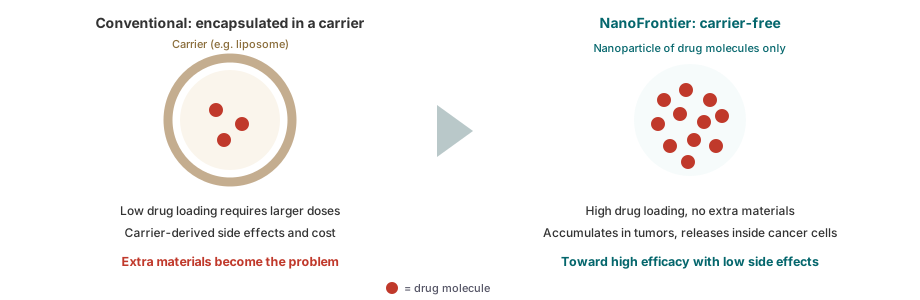
- Carrier-free: Nanoparticles consist solely of drug molecules, achieving high drug loading while avoiding carrier-derived toxicity and cost
- Water solubility: Hydrophobic drugs can be stably dispersed in water without altering their chemical structure
- Accumulation in tumors: Tumor blood vessels have larger gaps than those in healthy tissue, so nanoparticles of appropriate size pass through and accumulate in tumors (the EPR effect)
- Selective release inside cancer cells: Designing the molecule to release the drug in response to substances found at high concentrations inside cancer cells limits the impact on healthy cells
Research: Nano-Prodrugs
The research group of Professor Hitoshi Kasai (Institute of Multidisciplinary Research for Advanced Materials, Tohoku University), our technical advisor, published results demonstrating this concept in the journal Nanoscale in 2024.
The study produced nanoparticles (nano-prodrugs) composed exclusively of a prodrug formed by linking two molecules of the anti-cancer agent SN-38 — a design that uses no polyethylene glycol (PEG) or any other additive.
- Selective drug release inside cancer cells: The bond linking the molecules remains stable in the bloodstream but is cleaved by glutathione, which is present at high concentrations inside cancer cells (several times that of normal cells and about 1,000 times the extracellular level), releasing active SN-38
- High dispersion stability: The nanoparticles remain stably dispersed in saline over long periods without additives
- Strong antitumor activity in animal studies: At an equivalent SN-38 dose, the nano-prodrugs suppressed tumor growth more strongly than irinotecan, a clinically used prodrug of SN-38
These results were achieved by combining improved tumor accumulation from the nanoparticle size effect with a targeted drug-release mechanism.
Tanita, K., Koseki, Y., Kasai, H. et al. “Carrier-free nano-prodrugs for minimally invasive cancer therapy”, Nanoscale, 2024, 16, 15256.
Use Cases
| Envisioned Companies / Organizations | Needs |
|---|---|
| Pharmaceutical companies (R&D and formulation) | Nano-formulation of poorly water-soluble candidate compounds; higher drug loading and fewer side effects through carrier-free design |
| Drug discovery ventures | Advancing promising compounds stalled by poor water solubility |
| CDMOs and contract formulation companies | Acquiring nanoparticle formulation capabilities and expanding contract services |
| Universities and research institutes | Preparing dispersions of poorly soluble compounds for animal studies and efficacy evaluation |
| Agrochemical and functional materials manufacturers | Imparting water solubility to poorly soluble compounds beyond pharmaceuticals |
How We Work Together
Collaboration can start with a technical verification of whether your poorly water-soluble compound can be nanoparticulated and dispersed in water. You provide the compound, and we evaluate feasibility and dispersion stability in our laboratory. Feel free to start with a simple request: “we want to disperse this compound in water.”
Contact
For detailed materials or inquiries about joint research and technical verification, please feel free to contact us through our contact form.
Other Solutions
A rare-metal-free electrolyte using organic nanoparticles as the active material, aiming to commercialize safe, low-cost next-generation redox flow batteries.
Dispersing nanoparticles in coolants improves thermal conductivity and heat transfer while maintaining viscosity — enhancing cooling efficiency for data center immersion cooling, EVs, power electronics, and more.
Nanoparticle additives dramatically reduce friction and wear in lubricants without molybdenum-based additives, whose toxicity is a growing concern — extending machine life and saving energy while reducing environmental impact.