Coolant Performance Enhancement
Dispersing nanoparticles in coolants improves thermal conductivity and heat transfer while maintaining viscosity — enhancing cooling efficiency for data center immersion cooling, EVs, power electronics, and more.
Data Center Power Consumption and the Cooling Challenge
Driven by the spread of generative AI, power consumption by data centers is surging worldwide. According to estimates by JST (Japan Science and Technology Agency), data center power consumption is projected to grow from roughly 183 TWh in 2018 to about 3,020 TWh by 2030 — approaching one tenth of global electricity generation.
Cooling equipment is estimated to account for around 45% of data center power consumption, making cooling efficiency the top energy-saving priority. Against this backdrop, immersion cooling — submerging servers directly in coolant — is beginning to spread as a method that can dramatically reduce cooling power compared with conventional air cooling, and the share of liquid cooling is projected to grow rapidly over the next several years.
As cooling shifts from air to liquid, the next bottleneck is the heat transport performance of the coolant itself.
- The thermal conductivity of water- and oil-based coolants is limited and cannot keep up with rising heat density
- A “thermal boundary layer” forms at the interface between hot solids and the coolant, acting as a major thermal resistance that reduces heat transfer
- Adding particles to raise thermal conductivity has long been studied, but conventional approaches cause particle aggregation and higher viscosity, leading to increased pump power and pipe clogging
These performance limits are not unique to data centers. They are common to every application that moves heat with liquids — EV batteries, motors, and inverters; power semiconductors; transformers; machine tools; and heat exchange in industrial plants. NanoFrontier works on performance enhancement for a wide range of coolants and thermal fluids, both water- and oil-based, well beyond immersion cooling fluids for data centers.
Our Approach
Using our proprietary nanoparticle technology, NanoFrontier is developing nanoparticle-dispersed coolants with high dispersion stability and minimal aggregation.
- Drop-in replacement: Cooling performance can be improved simply by replacing the coolant with a nanoparticle dispersion — no changes to existing equipment
- Better heat transfer without higher viscosity: Tens-of-nanometer particles alter heat transport near the interface (disrupting the thermal boundary layer), improving heat transfer from solid to coolant without compromising fluidity
- Compatible with a wide range of fluids: Dispersion can be designed for the customer’s coolant, from water-based fluids to oils (thermal and cooling oils)
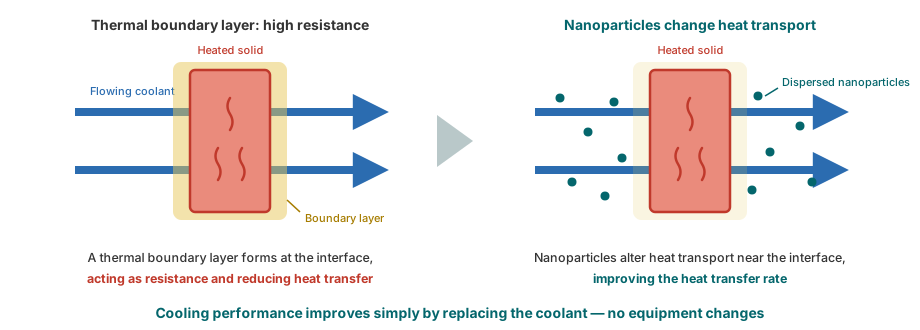
Improvements in cooling performance through nanoparticle dispersion are widely reported in the literature, with examples of thermal conductivity and heat transfer coefficient gains ranging from several percent to several tens of percent. Our goal is to bring this design potential to practical levels with our proprietary dispersion technology.
Market Opportunity
The global immersion cooling fluid market is projected to grow from approximately $2.3 billion in 2024 to $4.2 billion in 2030, a CAGR of 10.8% (Research and Markets). Including thermal fluids and automotive coolants, the related market is expected to exceed $15 billion by 2030, with broad applications beyond data centers.
Use Cases
| Envisioned Companies / Organizations | Needs |
|---|---|
| Data center operators and immersion cooling system integrators | Higher cooling efficiency and energy savings through improved coolant heat transport |
| Coolant, thermal fluid, and lubricant manufacturers | Joint development to differentiate existing products through nanoparticle dispersion |
| Automotive and EV manufacturers | Improved coolants for battery, motor, and inverter thermal management |
| Power electronics and semiconductor manufacturers | Raising the cooling limits of increasingly heat-dense equipment |
| Plant and factory engineering | Energy savings through more efficient waste heat recovery and heat exchange |
How We Work Together
Collaboration can start with a small-scale technical verification using your current coolant or cooling oil — confirming nanoparticle dispersion and the resulting change in cooling performance — and proceed step by step toward practical deployment. Feel free to start with a simple request: “we want to improve this coolant.”
Contact
For detailed materials or inquiries about technical verification and joint development, please feel free to contact us through our contact form.
Other Solutions
A rare-metal-free electrolyte using organic nanoparticles as the active material, aiming to commercialize safe, low-cost next-generation redox flow batteries.
Nanoparticle additives dramatically reduce friction and wear in lubricants without molybdenum-based additives, whose toxicity is a growing concern — extending machine life and saving energy while reducing environmental impact.
Carrier-free drug delivery that nanoparticulates the drug itself — releasing the active agent selectively inside cancer cells to combine high efficacy with low side effects.