Reducing Metal Wear in Lubricants
Nanoparticle additives dramatically reduce friction and wear in lubricants without molybdenum-based additives, whose toxicity is a growing concern — extending machine life and saving energy while reducing environmental impact.
Friction, Wear, and the Role of Lubricant Additives
Inside every machine — engines, transmissions, bearings, gears, machine tools — metal surfaces rub against each other. Energy loss from friction and component degradation from wear determine machine life, efficiency, and maintenance cost.
Lubricants therefore contain additives such as friction modifiers and anti-wear agents, and it is no exaggeration to say that additives define a lubricant’s performance. The global friction modifier market is projected to grow at around 8% annually toward 2030, and its importance continues to rise amid electrification and efficiency demands.
Challenges of Molybdenum-Based Additives
Organic molybdenum additives such as MoDTC (molybdenum dithiocarbamate) have been widely used as friction modifiers, particularly in automotive engine oils. Despite their excellent friction reduction, several issues have been raised:
- Toxicity and environmental concerns: Concerns over the toxicity and environmental impact of molybdenum compounds are driving a move away from their use, particularly in Europe
- Damage to exhaust aftertreatment systems: Additives containing sulfur and phosphorus degrade catalysts and diesel particulate filters, making low-SAPS (sulfated ash, phosphorus, sulfur) formulations an industry-wide trend
- Lack of alternatives: Demand is growing for molybdenum-free additives with equal or better anti-wear performance, but no definitive alternative has been established
Our Approach
Using our proprietary nanoparticle technology, NanoFrontier is developing nanoparticle additives that dramatically reduce metal wear without molybdenum.
When nanoparticles are added to lubricants, they are known to act between rubbing metal surfaces in several ways that reduce friction and wear:
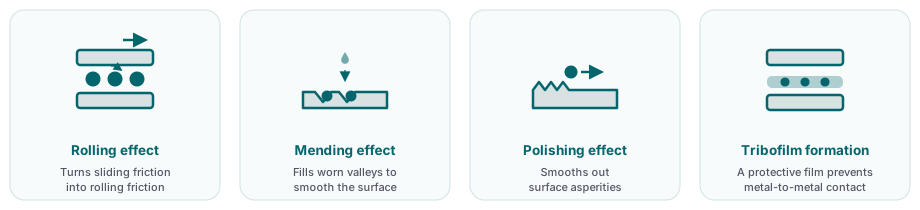
- Rolling effect: Fine particles act like miniature bearings, converting sliding friction into rolling friction
- Mending effect: Particles fill in worn surface asperities, reducing surface roughness
- Polishing effect: Particles smooth surface protrusions, reducing initiation points of localized wear
- Protective film formation: A tribofilm forms on metal surfaces, preventing direct metal-to-metal contact
Recent literature confirms that nanoparticle additives can substantially reduce wear and friction in lubricants:
| Literature Example | Base Oil | Concentration | Wear Scar Diameter | Friction Coefficient |
|---|---|---|---|---|
| Scientific Reports (2023) | Diesel engine oil (20W40) | 0.05 wt% | ~36% reduction | ~68% reduction |
| Applied Sciences (2025) | Engine oil (SAE 20W-50) | 2% | 1.744 mm → 0.875 mm (roughly halved) | 0.119 → 0.085 (~29% reduction) |
Both are published examples using metal-based nanoparticles. Effects vary by particle type, concentration, and conditions.
With our proprietary technology for precise particle size control at tens of nanometers and stable, aggregation-free dispersion in oils, we aim to deliver this wear reduction as a molybdenum-free additive.
Use Cases
| Envisioned Companies / Organizations | Needs |
|---|---|
| Lubricant and additive manufacturers | Joint development of molybdenum-free friction modifiers; upgrading and greening existing products |
| Automotive and transport equipment manufacturers | Longer life and better fuel/electricity economy through reduced wear in engine oils and drivetrain fluids |
| Industrial and machine tool manufacturers | Extended maintenance intervals through reduced wear in bearings, gears, and sliding parts |
| Wind power and infrastructure operators | Higher availability through longer life of hard-to-replace components such as gearboxes |
| Marine and construction machinery manufacturers | Longer machine life and lower maintenance costs under high loads and harsh environments |
How We Work Together
Collaboration can start with a small-scale technical verification using your current lubricant or base oil — confirming nanoparticle dispersion and the resulting changes in friction and wear characteristics — and proceed step by step toward practical deployment. Feel free to start with a request like “we want to improve this lubricant’s wear performance” or “we want to go molybdenum-free.”
Contact
For detailed materials or inquiries about technical verification and joint development, please feel free to contact us through our contact form.
Other Solutions
A rare-metal-free electrolyte using organic nanoparticles as the active material, aiming to commercialize safe, low-cost next-generation redox flow batteries.
Dispersing nanoparticles in coolants improves thermal conductivity and heat transfer while maintaining viscosity — enhancing cooling efficiency for data center immersion cooling, EVs, power electronics, and more.
Carrier-free drug delivery that nanoparticulates the drug itself — releasing the active agent selectively inside cancer cells to combine high efficacy with low side effects.