Safe, Low-Cost Next-Generation Battery Development
A rare-metal-free electrolyte using organic nanoparticles as the active material, aiming to commercialize safe, low-cost next-generation redox flow batteries.
Growing Demand for Long Duration Energy Storage (LDES)
With the expansion of renewable energy, demand is growing worldwide for long-duration, large-capacity energy storage (LDES) that can absorb weather-driven fluctuations and store power for several hours to half a day. Analyses by the IEA and the U.S. Department of Energy position long-duration storage as core infrastructure for renewable energy integration.
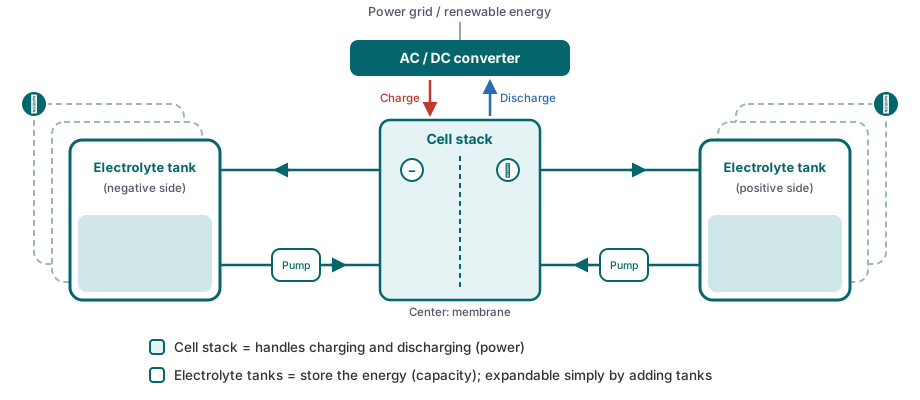
Among storage technologies, redox flow batteries have a structural advantage: the power unit (cell stack) and the energy unit (electrolyte tanks) can be designed independently, so capacity can be expanded flexibly simply by adding tanks. This makes them one of the most suitable technologies for long-duration, large-capacity applications.
In Japan as well, institutional design is rapidly drawing attention to non-lithium storage technologies, including redox flow batteries. In the long-term decarbonized power source auction operated by the Organization for Cross-regional Coordination of Transmission Operators (OCCTO), battery categories were explicitly divided in July 2025 into “lithium-ion batteries” and “other batteries (limited to batteries other than lithium-ion).” As a result, a growing number of utilities and operators are turning to flow batteries as a source of long-duration storage with capacity value. In particular, because the “other batteries” category avoids direct competition with lithium-ion, a favorable competitive environment is taking shape for redox flow batteries — with their long life, safety, and capacity scalability — and deployment studies are accelerating.
Against this background, the global redox flow battery market is projected to grow from approximately $7.6 billion in 2024 to $44 billion in 2030, a CAGR of 31% (Global Market Insights).
Challenges of Conventional Vanadium Redox Flow Batteries
While today’s mainstream vanadium redox flow batteries are easy to scale up in capacity, they face structural barriers to adoption:
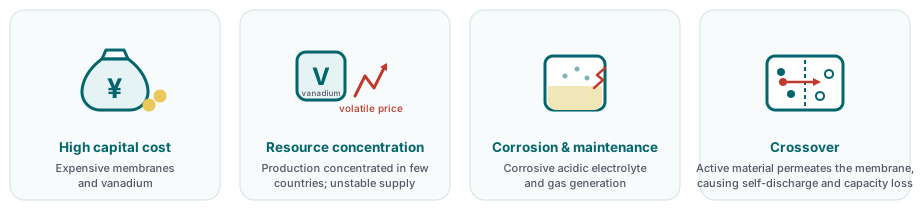
- High capital cost: Expensive ion-exchange membranes are required to prevent dissolved vanadium ions from crossing over, and vanadium itself is costly
- Resource concentration: Vanadium production is concentrated in a few countries, making supply unstable and prices volatile
- Corrosion and maintenance burden: Strongly acidic electrolytes create corrosion and hydrogen gas risks for tanks and piping, increasing inspection and maintenance costs
- Efficiency loss from crossover: Active materials passing through the membrane mix the two electrolytes, causing self-discharge and capacity loss
Our Approach
Building on organic nanoparticle technology originating at Tohoku University, NanoFrontier is developing next-generation redox flow batteries.
- Rare-metal-free electrolytes using organic nanoparticles — electrolytes composed of domestically sourceable materials, free from dependence on expensive rare metals such as vanadium
- Low-cost, high-safety redox flow battery cell stacks — designs that avoid highly corrosive electrolytes, reducing corrosion risk and maintenance burden and lowering overall system cost
- Grid-scale battery systems — aiming for practical use as long-duration storage infrastructure supporting the mass introduction of renewable energy
By realizing long-duration storage with domestically sourceable materials — without expensive rare metals or highly corrosive electrolytes — we contribute to building domestically produced energy storage infrastructure.
Current Initiatives
Adopted by Fukushima Prefecture’s FY2026 Regional Revitalization Practical Development Subsidy Program (regional issue resolution category), we are advancing development on a three-year plan. Under a partnership agreement with Namie Town, we are developing a rare-metal-free electrolyte utilizing seawater from the Fukushima coast, along with low-cost, high-safety redox flow battery cell stacks, based in the Hamadori region of Fukushima.
The project is aligned with Namie Town’s Zero Carbon City declaration and Hydrogen Town initiative, contributing to stable local use of renewable energy and the construction of domestically produced storage infrastructure. RYODEN Corporation, with extensive experience in battery sales and deployment, participates as market advisor to keep development aligned with market needs.
Use Cases
| Envisioned Companies / Organizations | Needs |
|---|---|
| Electric utilities and grid operators | Absorbing renewable fluctuations at substations and interconnection points, frequency regulation, and congestion relief |
| Renewable energy developers | Batteries co-located with solar and wind farms for smoothing output fluctuation and peak shifting |
| EPC and engineering companies | A non-lithium option for long-duration, large-capacity storage projects |
| Municipalities and community utilities | Local production and consumption of renewables, microgrids, and disaster resilience |
| Battery and materials manufacturers | Supply of electrolytes and active materials, and joint development to reduce redox flow battery costs |
Contact
For detailed materials or inquiries about joint development and demonstration projects, please feel free to contact us through our contact form.
Other Solutions
Dispersing nanoparticles in coolants improves thermal conductivity and heat transfer while maintaining viscosity — enhancing cooling efficiency for data center immersion cooling, EVs, power electronics, and more.
Nanoparticle additives dramatically reduce friction and wear in lubricants without molybdenum-based additives, whose toxicity is a growing concern — extending machine life and saving energy while reducing environmental impact.
Carrier-free drug delivery that nanoparticulates the drug itself — releasing the active agent selectively inside cancer cells to combine high efficacy with low side effects.