NanoFrontier Selected for Miyagi Prefecture 'New Market Entry and New Industry Creation Support Project Subsidy (Regional Innovation Creation Type)'
NanoFrontier Selected for Miyagi Prefecture Subsidy — Building a Continuous Manufacturing Process for Nanoparticle Dispersions to Strengthen R&D and Technology Validation
NanoFrontier Co., Ltd. (Head Office: Sendai, Miyagi; Representative Director: Seiya Inoue; hereinafter “NanoFrontier”) is pleased to announce its selection for Miyagi Prefecture’s FY2026 “Miyagi Prefecture New Market Entry and New Industry Creation Support Project Subsidy (Regional Innovation Creation Type).”
This subsidy program is designed to promote the creation of new industries through industry-academia-government collaboration and to facilitate market entry into advanced electronics and machinery industries. It provides partial funding for technology development and product development costs incurred by companies within the prefecture working in collaboration with universities and other institutions.
Background of Selection
NanoFrontier, building on its proprietary nanoparticle synthesis technology, provides R&D and technology validation services centered on the design, prototyping, and condition optimization of functional nanoparticles for chemical manufacturers, materials development companies, and research institutions. A key feature of the company’s approach is that it involves no contact-based grinding, which in principle minimizes the risk of foreign matter contamination, and it is applicable to a wide range of compounds.
When a substance is reduced to the nanoscale, its specific surface area increases dramatically, leading to significant improvements in reactivity, dispersibility, and in vivo absorption. Demand for these properties is growing, particularly for enhancing the value of poorly water-soluble active pharmaceutical ingredients and functional materials. The global nanoparticles market is projected to expand from approximately USD 18.5 billion in 2025 to approximately USD 54.6 billion in 2033, at a CAGR of 14.45% (Straits Research), while the broader nanotechnology market is expected to grow from approximately USD 91.2 billion in 2024 to approximately USD 332.7 billion in 2032, at a CAGR of 17.6% (Fortune Business Insights).
On the supply side, however, manufacturing infrastructure has not kept pace. The wet milling method dominant in industry relies on batch processing, which makes it difficult to increase utilization rates, carries the risk of metallic wear particle contamination from grinding media, and faces structural constraints in that production volume is dependent on equipment size. NanoFrontier itself had already achieved continuous synthesis at the laboratory scale, but had not yet reached the level required to advance from prototype supply to discussions about mass production — in terms of concentration, continuous operation time, and the range of applicable compounds.
In light of these changes in the business environment, the company applied for this project to elevate the manufacturing process itself — the foundation of its R&D activities — to a level suitable for industrial use, and was subsequently selected.

Planned Initiatives
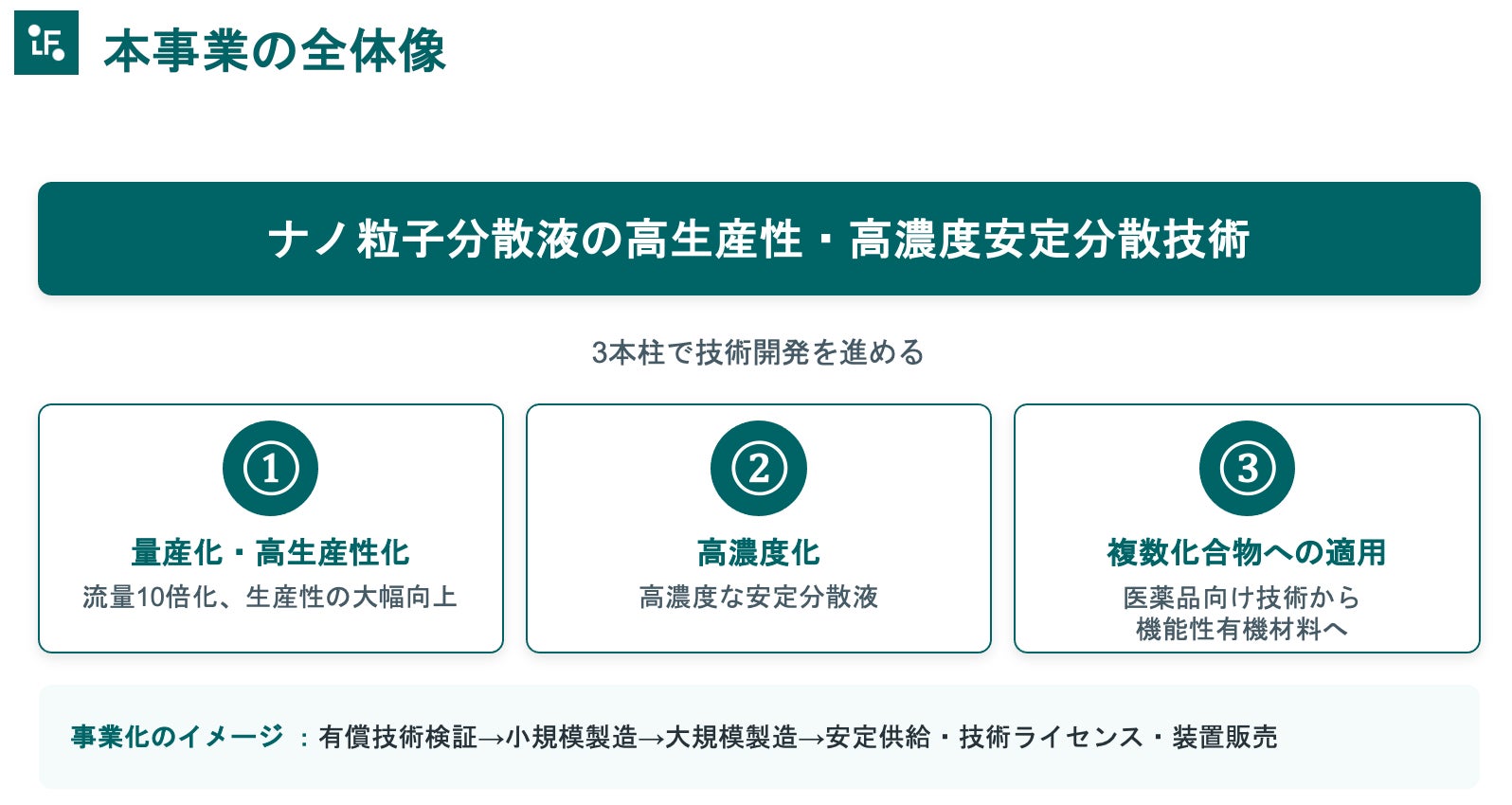
Through this subsidy project, NanoFrontier will advance the following initiatives. The implementation period spans a maximum of two years, from August 2026 through March 2028.
Scale-Up and Higher Productivity
NanoFrontier will design and fabricate a scaled-up continuous flow manufacturing system, progressively increasing throughput. In parallel, the company will incorporate process design elements for uninterrupted long-duration operation — including blockage detection in flow channels and partial in-line cleaning during operation — to achieve continuous operation suitable for industrial use.
Higher Concentration Production
To address the challenge of increased particle aggregation at higher concentrations, NanoFrontier will design the manufacturing process and the concentration/stabilization process as an integrated system, establishing conditions for producing stable dispersions at the concentration levels required for customer evaluation. Quality standards that suppress variation in particle size and size distribution and ensure reproducibility across lots will also be developed.
Expanded Applicability to Multiple Compounds
Operating conditions that have historically been optimized individually for each compound through empirical methods will be systematized into design rules derived from physicochemical data such as solubility parameters and molecular weight. This will shorten the time required to extend the technology to new compounds.
Comment from the Representative Director
“One year has passed since our founding, and through our R&D and technology validation work for chemical manufacturers, materials development companies, and research institutions, we have been consistently hearing requests for ‘higher concentrations and larger supply volumes.’ While the value that nanoparticle technology delivers is already widely recognized, the manufacturing infrastructure capable of supplying it continuously at stable quality has yet to be sufficiently established in society. We are truly delighted that our selection for this subsidy project will allow us to accelerate our efforts to translate phenomena confirmed in the laboratory into a manufacturing process that runs continuously without stopping. We will build a new supply foundation for the materials industry, starting from Miyagi.”
Seiya Inoue, Representative Director
About the Miyagi Prefecture New Market Entry and New Industry Creation Support Project Subsidy (Regional Innovation Creation Type)
This subsidy program, administered by Miyagi Prefecture, provides funding for technology development and product development costs incurred by companies within the prefecture working in collaboration with universities and other institutions, with the aim of promoting the creation of new industries through industry-academia-government collaboration and facilitating market entry into advanced electronics and machinery industries. The subsidy rate is up to one-half of eligible expenses (up to two-thirds for small-scale businesses), with a maximum subsidy of JPY 5 million per project per year and a maximum project period of two years.
Official Website: https://www.pref.miyagi.jp/soshiki/shinsan/innovation.html
Company Profile
- Company Name: NanoFrontier Co., Ltd.
- Representative: Seiya Inoue, Representative Director
- Address: Room 215, Material Solutions Center (MaSC), Tohoku University, 2-1-1 Katahira, Aoba-ku, Sendai-shi, Miyagi Prefecture
- Established: April 7, 2025
- Business Activities:
- R&D, manufacturing, and sales of reagents and functional materials using organic nanoparticle technologies
- Contract manufacturing of organic nanoparticles and provision of related technologies
- Technology licensing and consulting in the field of organic nanoparticle technologies
- Website: https://nanofrontier.jp
Last updated: 2026-08-20