NanoFrontier Selected for Miyagi Prefecture's FY2026 'Miyagi Environment-Related R&D Support Subsidy' (Development Initiation Category)
NanoFrontier Selected for Miyagi Prefecture’s FY2026 “Miyagi Environment-Related R&D Support Subsidy” (Development Initiation Category)
NanoFrontier Co., Ltd. (Head Office: Sendai, Miyagi; Representative Director: Seiya Inoue; hereinafter “NanoFrontier”) is pleased to announce its selection for Miyagi Prefecture’s FY2026 “Miyagi Environment-Related R&D Support Subsidy” (Development Initiation Category). Under this subsidy program, NanoFrontier will commence development of a “nanoparticle-dispersed high-efficiency coolant for data centers.”
Background
The global proliferation of generative AI and large-scale GPU clusters is driving a rapid surge in data center (DC) power demand worldwide. According to IEA estimates, global DC power consumption is projected to reach 945 TWh/year by 2030—approximately 2.3 times the 2024 figure of 415 TWh—accounting for roughly 3% of global electricity consumption. Cooling alone accounts for more than 30% of power consumption at some facilities, making it one of the primary energy cost drivers (IEA “Energy and AI,” April 2025 / LBNL 2024).
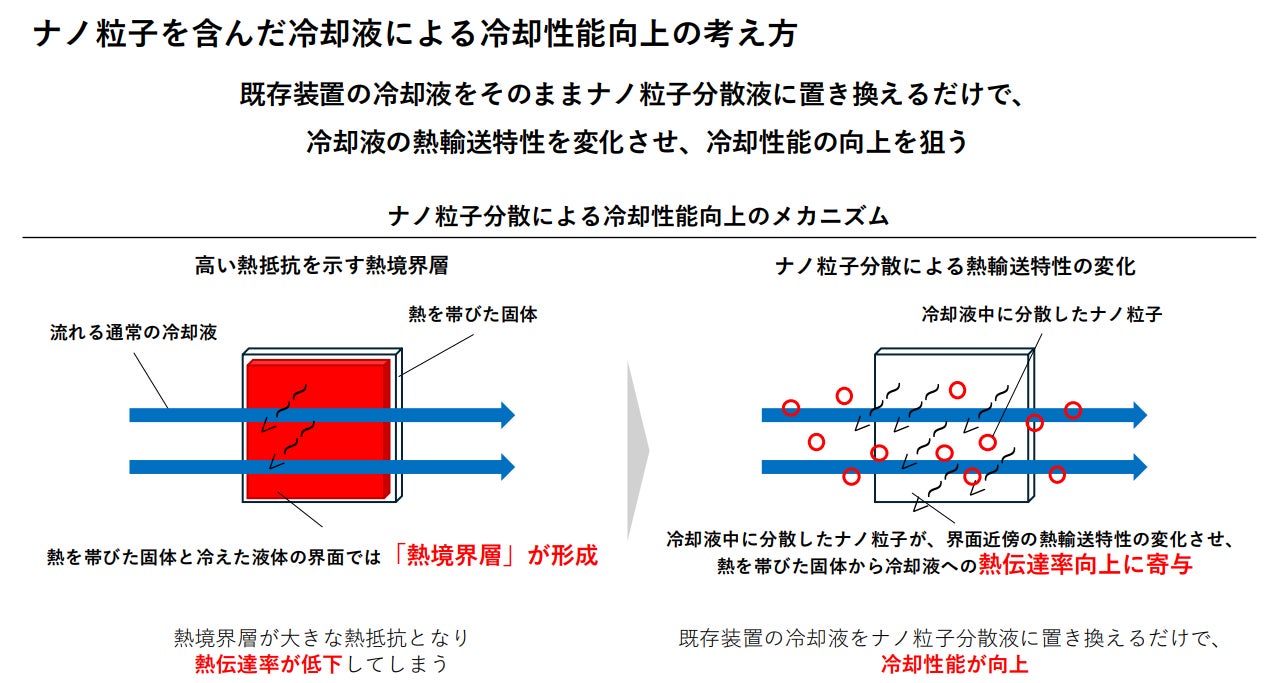
The heat transfer efficiency of cooling water—the medium that carries heat away—is a key determinant of cooling power consumption, yet it faces a structural challenge. Near the interface between a heat transfer surface and the cooling water, a “boundary film (thermal boundary layer)” forms where heat transfer is impeded, acting as thermal resistance and reducing the overall heat transfer coefficient. While increasing flow velocity can thin this boundary film, doing so raises pump power requirements and worsens overall energy efficiency.
NanoFrontier, building on nanoparticle synthesis and dispersion technologies developed at Tohoku University over more than 30 years, proposes an approach in which nanoparticles dispersed in cooling water disrupt and break down the boundary film near the interface—improving the heat transfer coefficient without increasing flow velocity. This business plan, aimed at reducing data center cooling power consumption and cutting CO₂ emissions associated with electricity use, was selected for the subsidy program.
Project Overview
This project will focus on establishing nanoparticle synthesis and dispersion technologies suited for cooling water applications, as well as conducting fundamental evaluations of the dispersion’s heat transfer performance and stability. The data obtained will serve as the basis for advancing performance evaluations in environments that simulate real-world equipment.
Expected Environmental Impact Reduction
This coolant aims to reduce data center cooling power consumption by enhancing the intrinsic heat transfer performance of the cooling water itself. Because it can be introduced as a drop-in replacement for existing cooling water systems—including chillers, CDUs (coolant distribution units), and chilled-water coils in air-handling units—it can contribute to energy savings without requiring large-scale facility modifications.
Reducing data center cooling power consumption directly translates to lower CO₂ emissions from electricity use. As adoption spreads to data centers both domestically and internationally, the technology is expected to contribute to the realization of a decarbonized society not only within Miyagi Prefecture, but on a global scale.
Note: Quantitative evaluation of environmental impact reduction will be conducted based on experimental data obtained through this subsidy project.
Market Growth Potential
Driven by the growing adoption of direct-to-chip liquid cooling, the liquid cooling market for data centers is projected to grow from USD 4.07 billion in 2026 to USD 27.65 billion in 2033, at a compound annual growth rate of 31.5% (MarketsandMarkets, 2026). NanoFrontier will steadily advance product development targeting this high-growth market.
Comment from the CEO
“We are deeply honored to have been selected for the Miyagi Environment-Related R&D Support Subsidy. Data centers—the backbone of AI’s advancement—are now at the forefront of the world’s energy and environmental challenges. We will apply nanoparticle synthesis technologies cultivated at Tohoku University over more than 30 years to the social challenge of cooling, and develop products that contribute to the decarbonization of data centers worldwide, starting from Miyagi and Sendai. Empowered by the support of our home prefecture of Miyagi, we will move forward with development in a steady and deliberate manner.”
Seiya Inoue, Representative Director
About the Miyagi Environment-Related R&D Support Subsidy
This subsidy, administered by Miyagi Prefecture, is a program that partially subsidizes costs associated with research and development that contributes to reducing environmental burdens such as CO₂ emissions within the prefecture. The “Development Initiation Category (Step 1)” selected in this round targets initiatives that represent the first steps toward R&D contributing to CO₂ emission reductions within Miyagi Prefecture.
Official website: https://www.pref.miyagi.jp/soshiki/kankyo-s/r05-setubikaihatu.html
Company Profile
- Company Name: NanoFrontier Co., Ltd.
- Representative: Seiya Inoue, Representative Director
- Address: Room 215, Material Solutions Center (MaSC), Tohoku University, 2-1-1 Katahira, Aoba-ku, Sendai-shi, Miyagi Prefecture
- Established: April 7, 2025
- Business Activities:
- R&D, manufacturing, and sales of reagents and functional materials using organic nanoparticle technologies
- Contract manufacturing of organic nanoparticles and provision of related technologies
- Technology licensing and consulting in the field of organic nanoparticle technologies
- Website: https://nanofrontier.jp